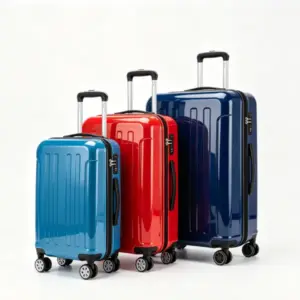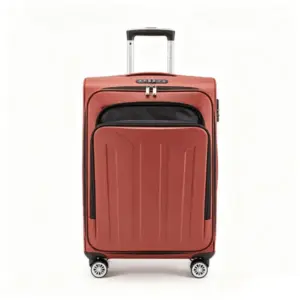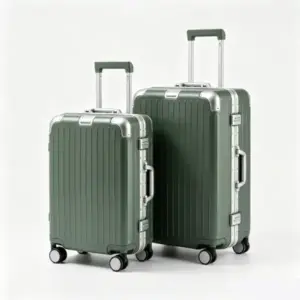
Material selection is one of the most important decisions when developing a luggage product line. Among the many options available, ABS and polycarbonate (PC) remain the two most commonly used materials for hard shell luggage.
Understanding the differences between these materials helps brands, distributors, and wholesalers choose the most suitable products for their target customers.
Understanding ABS Luggage
ABS (Acrylonitrile Butadiene Styrene) is a thermoplastic material widely used in luggage manufacturing.
It has become popular because it offers a balance between cost, appearance, and performance.
Advantages of ABS Luggage
Affordable Cost
ABS luggage is generally more economical than polycarbonate luggage.
This makes it suitable for:
- Mass-market retailers
- Discount stores
- Promotional product programs
- Budget-conscious consumers
Easy Manufacturing
ABS is easy to process and mold into various shapes and textures.
Manufacturers can produce:
- Gloss finishes
- Matte finishes
- Textured surfaces
This flexibility helps brands create attractive product designs.
Good Impact Resistance
Although not as strong as polycarbonate, ABS still provides reasonable protection for everyday travel needs.
Limitations of ABS Luggage
ABS may become more brittle over time compared to higher-grade materials.
Under extreme impacts, it can crack more easily than polycarbonate.
Understanding Polycarbonate Luggage
Polycarbonate is considered a premium luggage material.
It is commonly used by high-end luggage brands due to its excellent durability and lightweight performance.
Advantages of Polycarbonate Luggage
Exceptional Durability
Polycarbonate has excellent impact resistance.
Instead of cracking, the material tends to flex and return to its original shape after impact.
Lightweight Construction
Polycarbonate offers a strong strength-to-weight ratio.
Travelers benefit from:
- Easier handling
- Reduced airline weight concerns
- Improved user experience
Premium Appearance
Polycarbonate luggage often delivers a more sophisticated appearance.
This makes it suitable for premium retail markets.
Limitations of Polycarbonate Luggage
The primary disadvantage is cost.
Polycarbonate typically costs more than ABS, resulting in higher product prices.
ABS vs Polycarbonate: Key Comparison
Cost
ABS wins when affordability is the primary objective.
Polycarbonate requires a larger investment but delivers superior performance.
Durability
Polycarbonate clearly outperforms ABS in impact resistance and long-term durability.
Weight
Polycarbonate generally offers lighter construction while maintaining excellent strength.
Market Positioning
ABS is ideal for:
- Entry-level products
- Promotional programs
- Budget retail channels
Polycarbonate is ideal for:
- Premium brands
- Travel specialty stores
- High-end e-commerce products
Which Material Should Distributors Choose?
The answer depends on market demand.
For developing markets and price-sensitive channels, ABS luggage often provides the best balance between cost and performance.
For premium retail channels and higher-margin product lines, polycarbonate offers better differentiation and customer satisfaction.
Many distributors choose to carry both ABS and PC collections to serve different customer segments.
Conclusion
ABS and polycarbonate both play important roles in today’s luggage market.
ABS provides affordability and design flexibility, while polycarbonate delivers superior durability and premium positioning.
By understanding customer expectations and market requirements, brands and distributors can select the right material and build successful luggage collections that meet evolving consumer demands.